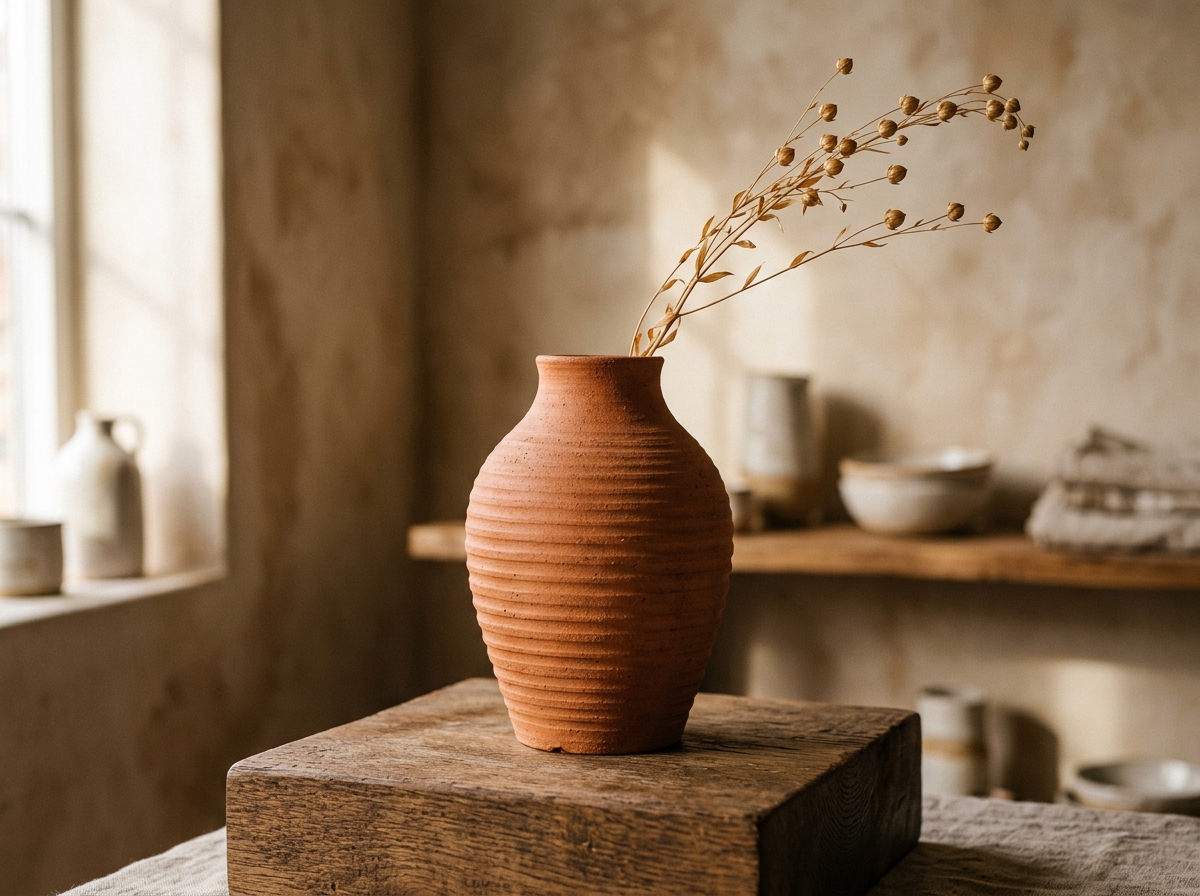
It is easy to accumulate decorative ceramics over time: an artisanal bowl found during a holiday in Portugal, a studio-thrown jug from a flea market in Brussels, or a sculptural stoneware vessel received as a gift. Yet when too many small objects gather on a single mantelpiece or dining credenza, individual silhouettes lose their impact, creating visual noise instead of tranquility.
In Japanese and Nordic aesthetics, empty space around an object—often called ma—is just as vital as the object itself. Giving a vase breathing room allows its curves, ribbing, and clay grain to be appreciated as functional art.
1. The Rule of Unequal Heights (Grouping in Threes)
When grouping decorative vessels, avoid arranging items of similar height in symmetrical pairs. Symmetrical arrangements often feel staged and rigid. Instead, gather three objects of contrasting scale:
- The Anchor: One tall, structured vase (28cm–35cm) that commands the vertical plane.
- The Companion: A mid-height piece (16cm–20cm) with rounded or bulbous proportions.
- The Ground: A low shallow dish or ceramic tray that connects the two vessels horizontally.
“When every surface is filled, nothing is highlighted. Simplicity requires having the confidence to leave empty space.”
2. Embracing Single-Stem Minimalism
You do not always need an expensive or elaborate floral bouquet. In fact, dense bouquets can conceal the sculptural neck of a beautiful ceramic vessel. A single architectural branch—such as a dried poppy seed pod, honesty branch, or wild olive twig—draws the eye toward the interplay between raw clay and botanical form.
3. Pairing Matte Clay with Polished Surfaces
Contrast creates interest. If your table is polished dark marble or lacquered wood, a matte, unglazed terracotta vase brings tactile grounding. Conversely, if your shelving is rough textured oak or lime-washed plaster, mouth-blown glassware adds reflective luminosity.