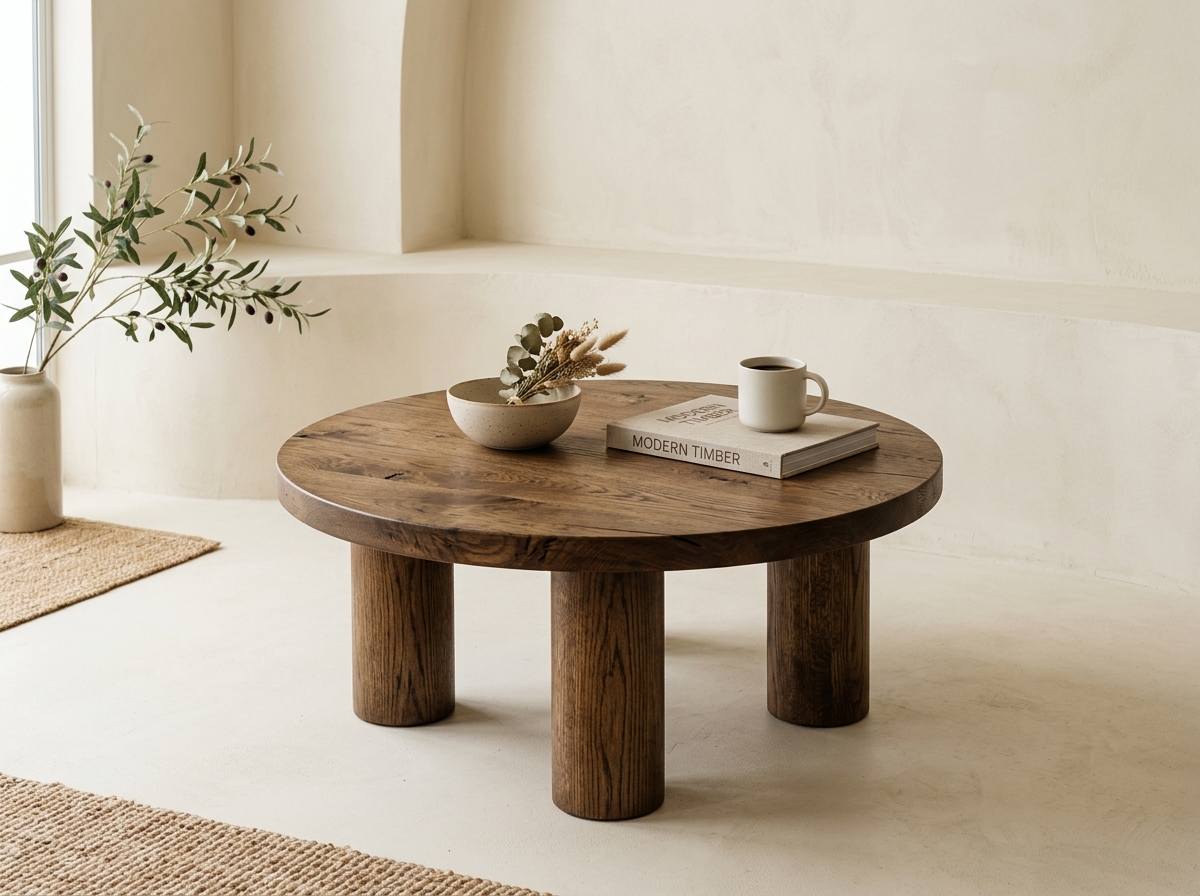
Throughout Amsterdam, Paris, Copenhagen, and Berlin, compact living is the European norm. Historic architectural proportions—narrow room widths, high ceilings, or angled eaves—can feel restrictive when furnished with standard bulky retail furniture.
However, small rooms have an inherent advantage: they naturally nurture intimacy. When every object is chosen with intention, a compact living room feels bespoke, cozy, and effortlessly coherent.
1. Lower the Visual Horizon
When furniture stands tall with bulky backs and towering headrests, it subdivides a small room into disjointed cubicles. Choosing low-profile pieces—such as sofas with slim arm profiles and low solid oak coffee tables—leaves the vertical volume of the room uninterrupted.
- Sightline Continuity: When you can see the baseboards and wall corners behind furniture, the brain registers the full boundary of the room as larger.
- Circular Coffee Tables: Round tables eliminate sharp 90-degree corners, improving traffic flow in tight walkways between sofas and entertainment units.
“In a small room, every piece of furniture must earn its footprint through beauty, longevity, and functional clarity.”
2. Clear the Floor with Wall-Mounted Sconces
Floor space is your most precious asset. Cluttering corners with bulky tripod floor lamps or awkward extension cords fragments walking paths. Wall-mounted flush sconces—particularly unglazed bisque ceramic designs—free floor square meters while washing walls with soft indirect ambient light.
3. Keep the Color Palette Monochromatic and Warm
Avoid chopping up small rooms with high-contrast accent walls or busy wallpapers. A gentle tone-on-tone palette using Warm Ivory (`#F5F1E8`), Sage Mist (`#DDE3D5`), and raw natural linen allows boundaries to dissolve, creating a seamless visual sanctuary.